
In today’s manufacturing landscape, production planning is no longer just about scheduling machines and managing inventory. It is increasingly driven by data, efficiency, and predictability. One of the most overlooked yet powerful contributors to this transformation is energy monitoring.
As industries move toward smarter operations, integrating energy insights into production planning is becoming essential, not optional.
What is Energy Monitoring in Manufacturing?
Energy monitoring is the systematic collection and analysis of energy consumption data across machines, processes, and facilities.
Modern systems use IoT sensors, analytics platforms, and real-time dashboards to track:
- Machine-level energy consumption
- Process efficiency
- Peak demand patterns
- Energy cost fluctuations
This data becomes a critical input for production planning decisions.
Learn more about smart industrial optimization:
- https://daitansol.com/energy-management-system
- https://www.iea.org/commentaries/industrial-facilities-could-save-billions-by-implementing-energy-management
The Link Between Energy Monitoring and Production Planning
Traditional production planning focuses on:
- Demand forecasts
- Workforce availability
- Machine capacity
However, without energy insights, planning remains partially blind.
Energy monitoring introduces a new dimension:
How much energy each unit, process, or schedule actually consumes
This enables predictable, cost-efficient, and stable production cycles.
1. Data-Driven Production Forecasting
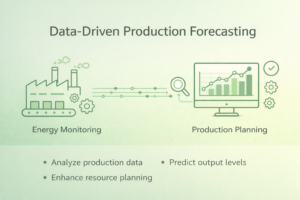
Energy monitoring allows manufacturers to correlate energy usage with production output.
For example:
- Machine A uses 10 kWh to produce 100 units
- Machine B uses 15 kWh for the same output
This metric, energy per unit, helps planners choose the most efficient production route.
Impact:
- Accurate production cost forecasting
- Better resource allocation
- More reliable delivery timelines
2. Improved Scheduling Based on Energy Demand
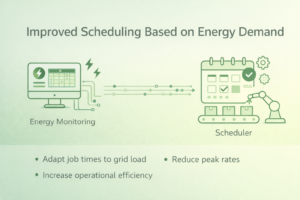
Energy costs fluctuate throughout the day, especially in industries using dynamic pricing models.
Energy monitoring helps:
- Identify peak demand periods
- Shift production to off-peak hours
- Avoid penalties and high tariffs
This ensures cost predictability in production planning, reducing financial uncertainty.
3. Real-Time Visibility for Faster Decision-Making
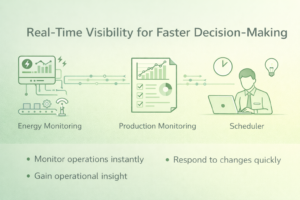
Modern energy monitoring systems provide real-time dashboards and alerts.
If:
- Energy consumption spikes
- A machine becomes inefficient
- Production deviates from expected patterns
Managers can act immediately.
This reduces:
- Production delays
- Unexpected downtime
- Planning inaccuracies
Real-time monitoring enables adaptive production planning, rather than reactive adjustments.
4. Early Detection of Inefficiencies and Failures
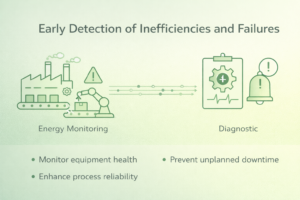
Unexpected machine behavior often reflects in abnormal energy consumption.
Energy monitoring helps detect:
- Equipment faults
- Idle running losses
- Process inefficiencies
This allows teams to:
- Schedule maintenance proactively
- Avoid unplanned downtime
- Maintain production continuity
It directly supports predictive maintenance strategies, ensuring smoother production cycles.
5. Enhanced Production Stability and Consistency
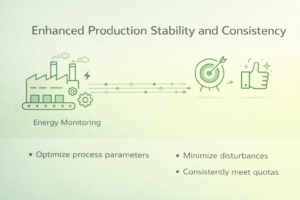
Production planning depends heavily on consistent machine performance.
Energy monitoring ensures:
- Standardized operations across shifts
- Reduced variability in output
- Stable production conditions
This leads to:
- More reliable production schedules
- Improved quality control
- Better customer satisfaction
6. Optimization of Resource Utilization
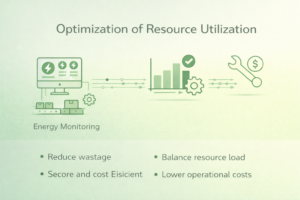
Energy monitoring extends beyond electricity and includes:
- Gas
- Water
- Compressed air
- Thermal systems
By analyzing these resources, manufacturers can:
- Eliminate waste
- Balance loads
- Optimize production flow
This creates a more efficient and predictable production environment.
7. Cost Predictability and Financial Planning
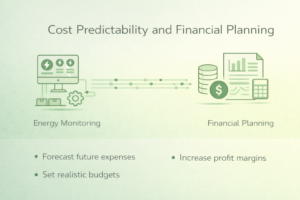
Energy is one of the largest operational costs in manufacturing.
With monitoring systems:
- Companies can identify high-cost processes
- Optimize energy-intensive operations
- Forecast energy expenses accurately
According to the International Energy Agency (IEA), industrial energy management can deliver significant cost savings and efficiency improvements.
8. Supporting Sustainable and Scalable Production
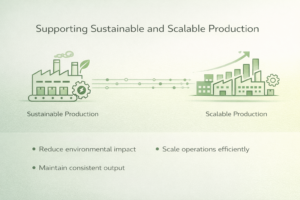
Energy monitoring plays a key role in sustainability by enabling:
- Reduced carbon emissions
- Efficient energy usage
- Compliance with environmental standards
At the same time, it supports:
- Scalable production
- Long-term operational planning
Real-World Perspective
Without energy monitoring:
- Planning relies on assumptions
- Inefficiencies remain hidden
- Costs fluctuate unpredictably
With energy monitoring:
- Every process has measurable energy data
- Production becomes optimized and predictable
- Decision-making improves significantly
Result:
✔ Lower operational costs
✔ Better production accuracy
✔ Increased efficiency
How Daitan Solutions Supports Energy-Driven Manufacturing
To fully leverage energy monitoring, businesses need integrated systems and expert guidance.
At Daitan Solutions, we help organizations:
- Implement Energy Management Systems (EnMS) aligned with ISO standards
- Enable real-time energy monitoring across operations
- Integrate energy data into production planning
- Identify inefficiencies and optimize performance
- Reduce operational costs while improving predictability
Explore more:
Conclusion
Energy monitoring is no longer just about tracking consumption—it is a strategic tool for predictable production planning.
By transforming raw energy data into actionable insights, manufacturers can:
- Plan with accuracy
- Operate with efficiency
- Scale with confidence
Organizations that adopt energy-driven planning today will lead the next generation of smart manufacturing.
Power Your Production Planning with Daitan Solutions
Looking to bring predictability, efficiency, and control into your production processes?
Daitan Solutions helps you implement intelligent energy monitoring systems that turn data into real operational advantage.
Get in touch today:
https://daitansol.com/contact
Start planning your production with precision, not assumptions.