
In manufacturing, production planning is often viewed through the lens of machine availability, manpower allocation, and raw material readiness. While these variables are essential, one operational factor remains consistently underestimated despite having a direct influence on production reliability: energy and utility performance.
Factories depend on stable electricity, compressed air, steam, chilled water, and process utilities to maintain output. Yet many production schedules are built without real visibility into how these utilities behave under load. As a result, manufacturers frequently experience deviations between planned production and actual output, not because machines are unavailable, but because the systems supporting them are operating inefficiently or unpredictably.
Energy monitoring addresses this gap by transforming utilities from invisible overhead into measurable operational inputs. When manufacturers can see exactly how energy and utilities behave across production processes, planning becomes more accurate, capacity becomes more predictable, and operations become significantly more stable.
Why Production Planning Often Becomes Unpredictable

Many manufacturers still rely on historical averages when forecasting production capacity. A machine may be rated for a certain throughput, and based on that specification, planners schedule output accordingly. However, real-world production rarely matches theoretical capacity.
Utility instability, fluctuating machine performance, hidden inefficiencies, and infrastructure limitations frequently reduce achievable output. A production line may appear available on paper while underperforming in practice because compressed air pressure is unstable, voltage quality is poor, or cooling systems are struggling under peak load.
Without energy and utility visibility, these constraints remain hidden until production targets are missed.
As highlighted in modern production planning best practices, manufacturers increasingly require real-time operational intelligence to improve forecasting and scheduling accuracy.
Energy Is a Direct Production Variable, Not Just an Overhead Cost
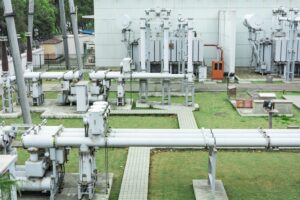
A common misconception in manufacturing is that energy is simply a financial metric. In reality, energy is deeply tied to operational capability.
Every production process relies on supporting utility systems. Electrical load affects machine performance. Compressed air pressure influences pneumatic equipment speed and reliability. Steam consistency impacts process quality in thermal operations. Cooling efficiency determines uptime in heat-sensitive environments.
When these systems fluctuate, production output fluctuates with them.
Energy monitoring allows manufacturers to treat utilities as measurable production variables rather than passive background infrastructure.
This is critical because production planning built without utility awareness is fundamentally incomplete.
How Energy Monitoring Improves Production Predictability
Energy monitoring provides operational teams with real-time insight into how infrastructure behaves during actual production. This visibility reveals patterns and constraints that traditional planning methods miss.
For example, a factory may technically have enough machinery to run multiple heavy-load production lines simultaneously, yet electrical monitoring may show that peak load conditions create voltage instability when those lines operate together. Without this insight, planners continue scheduling based on machine count alone, unknowingly introducing avoidable risk into the schedule.
Similarly, energy monitoring can reveal gradual performance degradation in machines or utility systems. A compressor consuming more power than normal, a chiller losing efficiency, or a motor drawing irregular load may indicate emerging maintenance issues long before failure occurs.
This is why many manufacturers integrate monitoring with Predictive Maintenance Strategies to proactively prevent performance-related disruptions.
Better Capacity Planning Through Real Operational Data
Production capacity is often misunderstood as a fixed number. In reality, capacity changes based on infrastructure performance, machine condition, utility availability, and process load.
Energy monitoring helps manufacturers understand their actual production capacity rather than theoretical maximums.
By correlating energy and utility data with production output, factories can determine how much infrastructure is required to support certain production targets. They can identify which shifts are most efficient, which processes consume disproportionate resources, and where bottlenecks occur under peak demand.
This enables far more accurate production forecasting and smarter allocation of operational resources.
Reducing Utility-Driven Downtime
Many production interruptions are mistakenly attributed to machinery when the real issue originates in supporting utilities.
A production line may stop due to insufficient compressed air pressure. A process may slow because cooling systems cannot maintain temperature. Equipment may trip because overloaded electrical systems create instability.
Without monitoring, these issues are treated as isolated machine problems rather than infrastructure-related constraints.
Energy monitoring exposes the root causes behind recurring disruptions, enabling manufacturers to resolve systemic issues rather than repeatedly addressing symptoms.
This directly improves schedule reliability and production consistency.
Supporting More Accurate Cost and Resource Forecasting
Predictable production planning is not only about meeting output targets, it is also about forecasting the cost of achieving those targets.
Energy monitoring provides manufacturers with measurable consumption data tied to actual production activity. This allows operations teams to understand the utility cost per batch, per shift, or per product line.
When production planning includes energy consumption visibility, management gains a more realistic understanding of the operational cost of different schedules, product mixes, and shift structures.
This improves budgeting, pricing, and profitability forecasting.
Energy Monitoring as an Operational Intelligence Tool
The most advanced manufacturers no longer view energy monitoring solely as a sustainability or cost-reduction initiative.
They treat it as a core operational intelligence system.
Energy data provides insight into:
- Infrastructure limitations
- Equipment health trends
- Utility bottlenecks
- Process inefficiencies
- Production readiness
This makes energy monitoring an essential layer of digital manufacturing maturity and smart factory operations.
Final Thoughts
Predictable production planning requires more than knowing which machines are available and when operators are scheduled. It requires visibility into whether the underlying infrastructure can consistently support the production demand being planned.
Without that visibility, manufacturers operate on assumptions.
With energy monitoring, they operate on measurable reality.
The result is more accurate scheduling, fewer unexpected disruptions, improved resource utilization, and stronger operational control.
In modern manufacturing, energy monitoring is no longer just a utility management practice, it is a strategic enabler of production predictability.
Improve Production Planning with Daitan Solutions
At Daitan Solutions, we help manufacturers gain real-time visibility into energy and utility performance through advanced industrial monitoring systems designed for operational intelligence.
Our solutions enable factories to monitor electricity, compressed air, water, steam, and machine-level consumption, helping operations teams improve planning accuracy, reduce downtime, and uncover hidden production constraints.
Visit www.daitansol.com to learn how Daitan Solutions can help you build smarter, more predictable manufacturing operations.
FAQs
1. How does energy monitoring improve production planning?
Energy monitoring provides real-time visibility into utility performance and infrastructure capacity, allowing manufacturers to plan production based on actual operating conditions rather than assumptions.
2. Why do utilities affect production predictability?
Utilities such as electricity, compressed air, and steam directly impact machine performance and process stability, making them essential to consistent output.
3. Can energy monitoring help reduce downtime?
Yes. It helps identify performance anomalies and utility issues before they cause production interruptions.
4. Is energy monitoring only useful for reducing costs?
No. While it supports cost reduction, it also improves operational visibility, maintenance planning, and production forecasting.
5. Which industries benefit most from energy monitoring?
Any manufacturing environment with energy-intensive or utility-dependent operations, including textile, FMCG, food processing, chemicals, and heavy industry—can benefit significantly.