A lot of what gets sold as an energy management system in Pakistan is, in practice, an energy monitoring system. It shows electricity, water, or compressed air consumption on a dashboard, in real time, with nice charts. That is genuinely useful. It is also only the first half of what the term implies. Monitoring tells a facility what happened. Management is what a facility does about it, and that second half is where most systems stop short.
This blog draws a clear line between the two, and explains what Daitan actually delivers once the dashboard is already showing accurate numbers.
1. What Monitoring Actually Gives You
Energy monitoring is the measurement layer. Meters and sensors capture electricity, water, and compressed air consumption, that data gets transmitted to a platform, and a dashboard displays it in a readable form, current usage, historical trends, consumption by department or equipment. A good monitoring system gives a facility visibility it did not have before, replacing a monthly utility bill with granular, near real time data.
Visibility on its own is valuable. It is also, by itself, passive. A dashboard showing that compressed air consumption never drops to zero overnight tells you there is probably a leak. It does not fix the leak, size the repair, or confirm the fix worked. Someone still has to look at the dashboard, interpret it correctly, and decide to act.
2. What Management Adds on Top
Energy management starts where monitoring stops. It takes the same underlying data and turns it into recommendations, benchmarks, action plans, and in some cases direct control over equipment, rather than leaving interpretation entirely to whoever happens to be looking at the screen that day. This is the difference between a system that reports a demand spike after it happens and a system built to flag load climbing toward a threshold while there is still time to stagger equipment startup and avoid it.
Put simply: monitoring answers “what is happening.” Management answers “what should we do about it, and in some cases, does it automatically.”
3. A Concrete Example: The Same Data, Two Different Outcomes
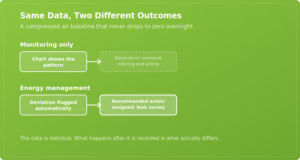
Take a compressed air baseline that never drops to zero overnight, a classic leak signature. A monitoring-only system shows this pattern on a chart and leaves it there. Whether anyone notices, correctly interprets it as a leak rather than normal variation, and follows up depends entirely on a human paying attention at the right moment.
An energy management approach treats that same pattern as a flagged deviation from expected baseline, surfaces it as something worth investigating rather than one line among hundreds on a dashboard, and connects it to a recommended next step, in this case scheduling a leak survey, rather than leaving the facility to independently conclude that action is needed.
4. Benchmarking: Turning Numbers Into Meaning
Raw consumption data on its own does not tell a facility whether a number is good or bad. Is 450 kWh per ton of product high or normal for this process? Is this month’s water use reasonable given production volume, or does it suggest a leak worth chasing? Energy management involves establishing benchmarks, against the facility’s own historical performance, against similar equipment or lines within the same site, and where relevant against industry norms, so that a number on a dashboard becomes a judgment: better than expected, worse than expected, or right on target.
Without benchmarking, monitoring data sits in a vacuum. A facility manager can see the number moving without knowing whether that movement matters.
5. Action Plans, Not Just Alerts
Many monitoring platforms can trigger an alert when a value crosses a threshold. Fewer connect that alert to a structured, prioritized plan for what to actually do next, and fewer still track whether the recommended action was taken and whether it worked. Energy management involves identifying inefficiencies, presenting action plans and benchmarks to facility leadership, and following through, ensuring proper installation and calibration, fine-tuning settings, and providing continued support and optimization beyond the point where the dashboard was first switched on.
The gap most systems leave open: An alert that fires and is never acted on has the same practical effect as no alert at all. The value is not in the notification, it is in what happens between the notification and the fix.
6. Direct Control, Where It Makes Sense
The most active end of energy management goes beyond recommending action and moves into directly adjusting equipment settings to reduce consumption, where the equipment and process allow for it. This is a meaningfully different capability from a dashboard that only displays data, since it closes the loop between detecting an inefficiency and correcting it, rather than depending on a person to read a report and manually intervene every time.
Not every facility needs or wants full automated control immediately, and it is not always the right starting point. But the distinction matters when evaluating what a system is actually capable of versus what it currently does by default.
7. Bringing Old Equipment Into the System
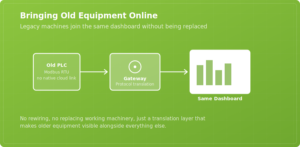
A genuinely useful part of energy management, as opposed to monitoring alone, is dealing with equipment that was never designed to be monitored in the first place. Older PLCs, meters, and machine controllers that only speak legacy protocols cannot report data to a modern platform on their own. Energy management includes engineering a way to bring that equipment online anyway, connecting it, translating its protocol, and integrating it into the same dashboard as newer equipment, so a facility does not need to replace working machinery just to gain visibility into it.
8. Reporting That Reaches Leadership, Not Just Engineers
Monitoring dashboards are typically built for whoever is watching them day to day, usually a facility or maintenance engineer. Energy management extends that reporting upward, structured summaries and automated reports delivered on a regular cycle, so that leadership sees benchmarked progress and action plans without needing to interpret a live dashboard themselves. This matters because budget decisions, whether to approve a leak repair program or a capacitor bank installation, are made above the level of the person watching the screen, and they need the same data presented in a form that supports a decision rather than raw charts.
9. Ongoing Support Instead of a One Time Installation
Monitoring can be treated as a one time installation: meters go in, the dashboard goes live, and the vendor’s job is largely done. Energy management treats deployment as the starting point rather than the finish line, continued support and optimization after go live, recalibration as conditions change, and in-house support available on an ongoing basis rather than only during the initial rollout. A facility’s operating conditions change constantly, new equipment, shifting production schedules, seasonal load patterns, and a system that stops adapting after installation day gradually drifts out of sync with how the facility actually runs.
10. Why This Distinction Matters When Evaluating a System
The practical reason to understand this distinction is procurement. A facility comparing options for utility monitoring should be clear about what it is actually being sold: a display layer that shows consumption, or a management layer that turns that data into benchmarks, action plans, and follow-through. Both have a place, and a monitoring-only system is not a bad starting point, but it is worth knowing which one is on the table before budgeting and expectations are set around it.
11. How Daitan Solutions Delivers This
Daitan’s Energy Management System is built to cover both layers rather than stopping at the dashboard. This includes bringing plant and machine level data online, including equipment without native communication capability, presenting that data through clear, user friendly dashboards, and going further, identifying gaps, developing and tailoring strategy, presenting action plans and benchmarks to leadership, ensuring proper installation and calibration, and providing continued support and optimization well beyond the initial rollout, with automated reporting and in-house support on an ongoing basis.
See what’s possible beyond a dashboard
Daitan Solutions can show you what energy management looks like when it goes beyond visibility into actual action and follow-through.
12. Frequently Asked Questions
Is energy monitoring the same thing as an energy management system?
Not quite. Monitoring is the measurement and visualization layer, showing consumption data on a dashboard. Energy management builds on that data with benchmarking, action plans, recommendations, and in some cases direct equipment control, extending well beyond simply displaying numbers.
Do we need full automated control to benefit from energy management?
No. Direct control over equipment settings is one capability within energy management, not a requirement. Many facilities benefit significantly from benchmarking, action plans, and structured follow-through alone, and can move toward automated control later if it fits their equipment and process.
Can old equipment without communication modules be included in an energy management system?
In most cases yes. Bringing a machine online, even without a native communication module, is typically possible by engineering a suitable connection, so a facility does not need to replace working equipment purely to gain visibility into it.
What happens after the initial installation and dashboard go live?
A management approach continues past go-live with calibration, fine-tuning, automated periodic reporting, and ongoing support, rather than treating installation as the end of the engagement.
Why does it matter whether a system delivers monitoring or full management?
It affects what a facility can realistically expect. A monitoring-only system provides visibility, but interpreting that data and acting on it falls to the facility itself. A management approach reduces that burden by turning data into benchmarked, prioritized action with follow-through built in.
13. The Bottom Line
A dashboard is not the finish line, it is the starting point. Seeing a number rise or fall in real time is useful, but it does not, by itself, tell a facility whether that number is good, what to do about it, or whether the fix actually worked. That is the work energy management does once the data is already flowing, and it is the part most systems quietly leave for someone else to figure out.