A generic facility audit checklist, fire exits, first aid kits, general housekeeping, will catch the obvious gaps in almost any factory. It will also miss most of what actually makes a textile mill dangerous, because the specific hazards inside a textile plant are genuinely different from a metal shop, a food plant, or a warehouse. Combustible lint hiding inside duct systems, dye-house chemistry, and high-speed rotating machinery each carry their own recognized hazard profile, and each needs to be checked specifically, not folded into a one-size-fits-all walkthrough.
This blog walks through what a facility audit actually looks for inside a textile plant, stage by stage, and why the risks are different enough from a generic factory to warrant that specificity.
1. Why Textile Facilities Need a Different Audit Lens
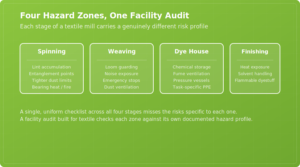
Textile production runs on a mix of continuous, high-speed rotating machinery and, in wet processing, high-temperature chemical operations, a combination that is unusual outside this industry and unusually unforgiving of shortcuts. A facility audit built around this reality checks four categories that carry particular weight in textile: fire and combustible dust risk, machine guarding and entanglement hazards, chemical handling in dyeing and finishing, and occupational health exposure from dust and noise across the floor. A checklist that treats a spinning mill the same as a general warehouse will pass on paper while missing the hazards actually documented across the sector.
2. Fire and Combustible Dust: The Sector’s Defining Risk
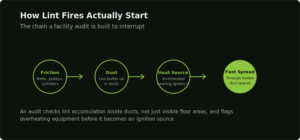
Fire is the single most consistently documented hazard category across the textile industry, and it is driven by a specific mechanism: combustible lint, dust, and fluff accumulating in concealed spaces, ductwork, enclosed equipment, and overhead areas, where a single ignition source can trigger a fast-spreading, high-intensity fire. Carding, spinning, and weaving machines generate this dust continuously through friction between cylinders, belts, and pulleys, and an overheated bearing or motor is a well documented ignition source for accumulated lint sitting nearby. In wet processing, the fire risk shifts character, flammable solvents and certain dyestuffs used in dyeing and printing introduce their own ignition and flash-fire potential, particularly where pre-treatment and finishing chemicals are stored or handled close to heat sources.
A facility audit checks lint and dust accumulation specifically inside duct systems and concealed spaces, not just visible floor areas, verifies extinguisher placement and inspection tags are current, confirms fire exits and clearances are unobstructed, and reviews whether flammable dyestuffs and solvents are stored and handled separately from ignition sources.
3. Machine Guarding: Where Entanglement Risk Concentrates
Spinning frames, carding machines, weaving looms, and knitting machines all involve fast-moving transmission components, belts, pulleys, gears, shafts, and rotating parts, that carry a well recognized entanglement and amputation risk. This is the category of hazard that machine guarding standards exist specifically to address: physical barriers, interlocks, and emergency stop mechanisms on power-transmitting components and nip points, verified as present, functional, and not bypassed or removed for convenience during a production run.
A facility audit checks that guards are physically present and properly secured on every machine, not just the ones nearest the entrance, that interlocks actually stop the machine when triggered rather than being defeated or taped over, and that emergency stop mechanisms are accessible and clearly marked along the length of long machine lines like weaving sheds and spinning frames.
4. Dye House Chemical Handling
Wet processing introduces a chemical hazard profile that spinning and weaving floors do not have. Dyeing, printing, and finishing operations use a genuinely large number of chemical formulations, thousands of distinct dyestuff structures across the industry, alongside auxiliary chemicals, solvents, and finishing agents, several of which carry documented health hazards on repeated exposure. This is also where pressure vessel equipment, slasher cylinder dryers and kiers among them, introduces a distinct mechanical risk category requiring its own inspection standard separate from general machine guarding.
A facility audit reviews whether chemicals are properly labeled and stored according to compatibility, whether safety data sheets are accessible at the point of use rather than filed away in an office, whether ventilation and fume extraction are functioning as designed in the dye house specifically, and whether workers handling dye chemistry have access to the specific personal protective equipment their process requires, not a generic factory-wide PPE policy.
Why generic PPE policies fall short here: A worker on a dyeing line handling reactive dyestuffs and a worker on a spinning floor managing yarn breaks face genuinely different exposure risks. A single, uniform PPE requirement across the whole facility usually means one of the two groups is under-protected.
5. Dust Exposure and Occupational Health
Beyond the fire risk it creates, airborne cotton dust is a recognized occupational health hazard in its own right, linked to a documented respiratory condition specific to this industry. Exposure limits are not uniform across departments either, spinning operations generally carry a tighter respirable dust threshold than weaving, reflecting the different dust concentrations each process generates. A facility audit checks ventilation and dust extraction performance by department rather than assuming a single ventilation standard covers the whole floor, and reviews whether dust-level monitoring, where it exists, is actually being logged and acted on rather than recorded and forgotten.
6. Ergonomic and General Physical Hazards
Textile work carries a distinct ergonomic profile, repetitive motion at spinning and weaving stations, awkward postures at certain machine types, and extended standing across long shifts, alongside more familiar physical hazards: excessive noise from mechanical looms and spinning frames, inadequate lighting at inspection and quality control points, and poor housekeeping creating slip and trip hazards around fiber and fabric handling areas. None of these individually make headlines, but they accumulate into a meaningful share of recordable incidents when left unaddressed, particularly in facilities running reactive rather than planned maintenance.
7. Worker Facilities Across Large, Multi-Shift Headcounts
Textile mills commonly run large workforces across multiple shifts, which puts real pressure on worker facilities, washrooms, drinking water access, and rest areas, that scale poorly if they were sized for a smaller original headcount as the facility expanded. A facility audit checks that worker facilities are adequate for actual shift-level headcount, not just facility-wide totals, and reviews whether changing and hygiene facilities are appropriately separated where contaminated work clothing, common in dye house environments, needs to stay out of general circulation areas.
8. How This Complements Buyer Compliance Audits
Much of what a facility audit checks overlaps directly with what BSCI, Sedex SMETA, and WRAP auditors look for, fire safety, machine guarding, worker facilities, and documentation, covered in more depth in our piece on what buyer compliance audits actually check. The difference is timing and depth: an internal facility audit run with the specific hazard profile of a textile operation in mind catches gaps before a buyer’s auditor does, and goes deeper into the sector-specific detail, dust exposure limits by department, dye chemistry storage, pressure vessel inspection, that a general buyer audit checklist may not probe as thoroughly.
9. Why Reactive Maintenance Makes Everything Above Worse
A recurring pattern across documented textile safety failures is the same root cause: maintenance that only happens after something breaks, rather than on a planned schedule. Equipment failure from unplanned maintenance is a well documented driver of textile safety incidents, since a machine guard left off after a reactive repair, a bearing running hot because scheduled lubrication was skipped, or a fire suppression system that was never tested on its planned interval, all trace back to the same underlying gap. A facility audit reviews maintenance records specifically to check whether inspection and servicing intervals are actually being kept, not just whether a maintenance program exists on paper.
10. How Daitan Solutions Helps
Daitan Solutions conducts facility audits for textile manufacturers across Pakistan with the sector’s specific hazard profile built into the process, rather than applying a generic industrial checklist. This includes fire and combustible dust risk assessment across spinning, weaving, and duct systems specifically, machine guarding verification department by department, dye house chemical handling and storage review, and documentation and maintenance record checks that catch the gaps behind most recordable incidents before they turn into one.
Get an audit built for how a textile mill actually operates
Daitan Solutions can run a facility audit that checks fire risk, machine guarding, and dye house handling specific to textile operations.
11. Frequently Asked Questions
Why is fire risk considered the defining hazard in textile facilities?
Combustible lint, dust, and fluff accumulate continuously in duct systems and concealed spaces from friction between machine components like cylinders, belts, and pulleys. Combined with an ignition source such as an overheated bearing, this creates conditions for fast-spreading, high-intensity fires that are specific to how textile machinery operates.
Are dust exposure limits the same across every textile department?
No. Exposure limits generally differ by operation, spinning departments typically carry a tighter respirable dust threshold than weaving, reflecting the different dust concentrations each process generates. A facility audit checks ventilation performance by department rather than applying one standard facility-wide.
How does a facility audit differ from a buyer compliance audit like BSCI or SMETA?
They overlap significantly in what they check, fire safety, machine guarding, worker facilities, and documentation, but an internal facility audit built around textile-specific hazards can go deeper into sector detail like dye chemistry storage and department-level dust exposure, and it happens on the facility’s own timeline rather than under a buyer’s audit deadline.
Why does reactive maintenance increase safety risk in textile plants?
Unplanned, reactive maintenance is a well documented driver of textile safety incidents, since deferred lubrication, skipped inspection intervals, and guards left off after emergency repairs all create conditions for equipment failure. A facility audit checks whether maintenance schedules are actually being followed, not just whether a program exists on paper.
What makes dye house chemical handling different from general factory chemical storage?
Textile dyeing and finishing use a large number of distinct chemical formulations, some with documented health hazards on repeated exposure, alongside pressure vessel equipment like dryers and kiers that carry their own inspection standard. This requires specific labeling, storage, ventilation, and PPE considerations beyond a generic factory chemical safety policy.
12. The Bottom Line
A textile mill’s risk profile is shaped by a specific combination most other industries do not share: continuous combustible dust generation, high-speed transmission machinery, and, in wet processing, a genuinely complex chemical handling environment. A facility audit that treats these as the specific, documented hazards they are, rather than folding them into a generic factory walkthrough, is what actually catches the gaps that matter before they become an incident, an insurance claim, or a failed buyer audit.