
Most facility managers in Pakistan focus on units consumed when they look at their electricity bill. Demand charges work on a completely different logic, and most people never notice them until the number is already large. A facility does not need to run at high load all month to trigger a high demand charge. It only needs to hit a high load once, for a matter of minutes, and that single peak can set the charge for the entire billing cycle.
This article explains what a demand charge actually is, how it gets calculated on an industrial bill in Pakistan, why it catches so many facilities off guard, and what real time monitoring actually does to bring it under control.
1. Energy Charges and Demand Charges Are Not the Same Thing
An electricity bill has two fundamentally different components sitting side by side. The energy charge is based on total consumption, the number of units used across the whole month, measured in kWh. The demand charge is based on the highest rate of consumption recorded at any point during the month, measured in kW or kVA, regardless of how long that rate was sustained or how little electricity was used the rest of the time.
A facility that runs a steady, moderate load all month can have a much lower demand charge than a facility that consumes the exact same total units but does so in short, sharp bursts. The bill is not just about how much electricity was used. It is also about how it was used.
2. How Maximum Demand Is Actually Measured
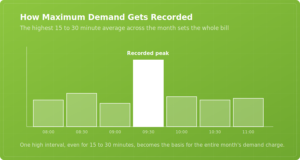
DISCO meters do not record demand as an instantaneous reading. They record it as an average over a fixed interval, typically 15 or 30 minutes, and the highest of these interval averages across the billing month becomes the recorded maximum demand. This means a very short spike, lasting only a minute or two, will not register as the full spike value. But if several pieces of heavy equipment start up together and stay running for the length of that measurement window, the demand charge is set for the entire month based on that one window.
3. What This Costs on a Pakistani Industrial Bill
Industrial tariffs in Pakistan carry a fixed demand-based charge on top of the per-unit energy rate. Connections above 5 kW commonly carry fixed charges in the range of Rs 1,250 per kW per month, billed against the sanctioned or recorded demand rather than actual energy consumed. On a facility with a 500 kW sanctioned or recorded demand, that fixed component alone runs into the hundreds of thousands of rupees every month, independent of how much energy was actually used.
Time of Use tariffs add another layer. Industrial energy rates during peak hours can run close to Rs 35 to 36 per unit, compared to roughly Rs 23 to 25 per unit off peak. A facility that lets its heaviest equipment run during the evening peak window is paying both the higher energy rate and contributing to the demand reading at the worst possible time.
4. The Ratchet Clause Most Facilities Do Not Know About
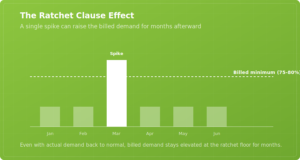
Many industrial tariffs include a ratchet clause, where the billed demand for the month is set at whichever is higher: the actual recorded demand for that month, or a fixed percentage, commonly 75 to 80 percent, of the highest demand recorded over the preceding several months. This means a single unusually high demand event does not just cost extra for one billing cycle. It can raise the minimum billed demand for several months afterward, even if the facility never approaches that peak again.
Why this matters: A one time equipment startup event, a maintenance overlap, or an unplanned coincidence of multiple heavy loads running together can quietly raise a facility’s demand charge baseline for months, long after the event itself is forgotten.
5. Why Demand Spikes Happen Without Anyone Noticing
Demand spikes are rarely the result of one obvious cause. They usually happen when several pieces of equipment that do not need to run together happen to start at the same time:
- Multiple large motors or compressors starting up within the same short window, often after a scheduled break or shift change
- HVAC systems cycling on simultaneously across a large facility during a temperature swing
- Production lines resuming together after a planned or unplanned stoppage
- Backup or standby equipment running in parallel with primary equipment during a transition
None of this looks unusual on the factory floor. Machines simply switching on is not something anyone tracks in real time unless there is a system actively watching total facility load as it happens.
6. Demand Charges Versus Power Factor Penalties
It is worth being clear about the distinction here, since both show up on the same bill and both relate to how a facility uses electricity, but they are separate charges caused by different things. Power factor penalties are driven by the ratio between real and reactive power, caused mainly by inductive equipment like motors and transformers. Demand charges are driven purely by the peak rate of electricity use, regardless of power factor. A facility can have a clean power factor and still carry a high demand charge, and vice versa. Both are worth reviewing, but fixing one does not fix the other.
7. Load Shedding on Purpose: What Peak Shaving Means
Peak shaving is the practice of deliberately reducing or shifting load during periods that would otherwise create a high demand reading. In practice this usually means staggering equipment startup instead of switching everything on together, shifting non essential loads like certain pumps or auxiliary equipment to off peak hours, and temporarily reducing non critical load during a brief period if a facility can see demand approaching a level it wants to avoid. None of this requires cutting production. It requires knowing, in the moment, that demand is climbing toward a level worth avoiding, which is precisely the piece most facilities are missing.
8. Why You Cannot Manage a Number You Cannot See
The core problem with demand charges is timing. The DISCO bill arrives weeks after the billing period ends, by which point the demand spike that set the charge has already happened and cannot be undone. A facility manager reviewing last month’s bill is looking at a number that was locked in weeks earlier. There is no way to react to a spike after the fact. The only point where a demand spike can actually be managed is while it is happening, which requires visibility in real time, not a monthly summary.
9. What Real Time Monitoring Actually Changes
A facility with continuous, real time visibility into total load can see demand climbing toward a critical threshold minutes before it would register as the month’s peak, not weeks after the bill arrives. This turns demand management from a retrospective exercise into an operational one. Instead of discovering after the fact that three pieces of equipment happened to start together, a facility manager or automated control system can see the trend forming and stagger the startup sequence, delay a non critical load, or get an alert before the interval window closes and the peak locks in for the month.
Over time, this same data also reveals the underlying pattern behind repeated demand spikes, whether it is a specific shift change, a particular combination of equipment, or a recurring maintenance overlap, turning a one-off fix into a permanent change to how the facility sequences its load.
10. Building a Demand Management Plan
A structured approach to controlling demand charges typically follows a few consistent steps. First, establish a clear baseline of how demand actually moves throughout a typical day and week, since most facilities have never looked at this pattern directly. Second, identify the specific events, equipment combinations, or times of day that create the highest peaks. Third, sequence or stagger the equipment responsible for those peaks rather than assuming nothing can be changed. Fourth, keep monitoring continuously, since operational patterns shift as production schedules, staffing, and equipment change over time, and a peak avoided this quarter can quietly reappear next quarter if nobody is still watching for it.
11. How Daitan Solutions Helps
Daitan Solutions works with industrial facilities across Pakistan to bring real time visibility to electrical demand, not just total consumption after the fact. This includes continuous load monitoring integrated into Daitan’s Energy Management System, dashboards that show demand trending toward critical thresholds as it happens rather than after the billing cycle closes, and historical pattern analysis that identifies which equipment combinations or time windows are responsible for a facility’s recurring demand peaks.
See your demand before it becomes next month’s bill
Daitan Solutions can give your facility real time visibility into peak load, so demand spikes get managed while they are happening, not discovered weeks later.
12. Frequently Asked Questions
What is the difference between a demand charge and an energy charge?
The energy charge is based on total electricity consumed over the billing period, measured in kWh. The demand charge is based on the highest rate of electricity use recorded during any single measurement interval in that period, typically 15 or 30 minutes, measured in kW or kVA.
Can a short spike in electricity use really affect the whole month’s bill?
Yes, if that spike lasts long enough to register within a full measurement interval, usually 15 to 30 minutes. The highest interval reading recorded anywhere in the billing month becomes the basis for the demand charge, regardless of how the facility used electricity the rest of the month.
What is a ratchet clause in an industrial electricity tariff?
A ratchet clause bills a facility’s demand at whichever is higher: the actual demand recorded that month, or a set percentage, often 75 to 80 percent, of the highest demand recorded over recent months. This means an unusually high demand event can raise the billed demand for several months afterward.
Are demand charges the same as power factor penalties?
No. Demand charges are based on peak rate of electricity use. Power factor penalties are based on the ratio of real to reactive power, driven mainly by inductive equipment like motors. They appear as separate items on the same bill and require separate approaches to manage.
How does real time monitoring actually reduce demand charges?
It allows a facility to see load climbing toward a peak while it is still happening, within the same measurement interval that will determine the month’s demand charge. That visibility allows equipment startup to be staggered or non critical loads to be delayed before the peak locks in, rather than discovering the spike weeks later on the bill.
13. The Bottom Line
Demand charges reward steady, predictable electricity use and penalize sudden peaks, even brief ones, in a way that most facilities never see coming until the bill is already in hand. By the time the bill arrives, the moment that set the charge is long gone and cannot be changed. The only way to actually manage a demand charge is to see it building in real time, while there is still a chance to do something about it, which is precisely what a monitored, continuously visible facility can do that one running on monthly bills alone cannot.