Searching for an “energy management company near me” may sound like a simple location-based decision. For a factory, commercial facility, textile mill, pharmaceutical plant, food manufacturer, or other energy-intensive operation, however, choosing the right company involves much more than finding the closest office.
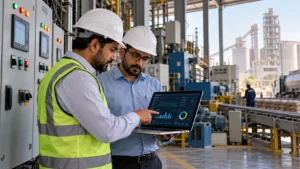
An Energy Management System has to work inside the actual operating environment of the facility. Engineers may need to study electrical distribution, identify major energy-consuming equipment, inspect existing meters and automation systems, understand production schedules, determine where additional instrumentation is required, configure communications, commission hardware, validate readings, train the facility team, and continue supporting the system after installation. That makes local availability important, but proximity alone is not enough.
The better question is not simply, “Which energy management company is closest to us?” It is: “Which company can understand our facility, design the right monitoring architecture, integrate it with our existing infrastructure, and continue supporting us after deployment?”
For Pakistani businesses, that distinction is important because energy-management requirements can vary significantly between industries and even between two factories producing similar products.
What Should an Energy Management Company Actually Do?
Before comparing companies, it helps to clarify what “energy management” means. Some providers primarily supply meters, sensors, or monitoring software. Others focus on energy audits. Some install electrical equipment but provide limited analytics after commissioning. Others may offer a broader Energy Management System that combines metering, industrial communication, dashboards, baselines, alerts, analytics, and engineering support.
These are not necessarily the same service. A complete energy-management engagement should begin by understanding how energy enters the facility, where it is distributed, which systems represent significant consumption, and what operational decisions the facility wants better data to support.
For electricity, that may include the main incomer, transformers, distribution boards, production lines, compressors, chillers, pumps, HVAC systems, large motors, furnaces, or other significant loads. Depending on the facility, the same project may also need visibility into natural gas, water, compressed air, steam, solar generation, or other utilities. The objective is not simply to install as many meters as possible. It is to create enough visibility to explain where energy is being consumed and identify when performance begins moving away from what the facility expects.
This distinction is also consistent with the broader concept of an Energy Management System under ISO 50001. The standard focuses on establishing, maintaining, and continually improving energy performance rather than merely measuring consumption. ISO 50001:2018 remains the current edition and was confirmed by ISO in 2024.
Why Local Engineering Support Matters in Pakistan
There is a practical reason businesses search specifically for an energy management company near them.
An EMS is not purely a software product.
A cloud dashboard can technically be accessed from anywhere, but the quality of the information displayed on that dashboard depends on what is happening inside the facility. Incorrect current-transformer installation, an improperly configured meter, a communication failure, incorrect scaling, missing production data, poor sensor placement, or an incomplete metering hierarchy can all reduce the usefulness of the system.
During implementation, engineers may need access to electrical single-line diagrams, distribution panels, machine information, existing PLCs, VFDs, SCADA systems, utility lines, compressor rooms, boiler systems, chillers, solar inverters, and production data.
After deployment, operating conditions can change. New machinery may be installed. Production lines may be reorganized. Utility distribution may change. Additional monitoring points may become necessary. A communication gateway may need troubleshooting. A sensor may require replacement or recalibration.
A company with the ability to provide local engineering, commissioning, and after-sales support can therefore offer an operational advantage over a solution that effectively ends once the software subscription begins.
For Pakistani industries, the ideal arrangement is often a combination of capable technology and locally available engineering support.
Start With a Facility Assessment, Not a Software Demonstration
One of the most useful ways to evaluate an energy management company is to observe what happens before a proposal is submitted.
If the conversation immediately becomes a demonstration of dashboards, charts, reports, and software features before anyone has studied the facility, the proposed solution may be based more on the product being sold than on the actual energy architecture of the plant.
A stronger process starts with questions.
Where does electricity enter the facility? How many transformers are operating? Which production areas consume the most power? Are individual production lines separately fed? How much energy is being used by compressors, chillers, boilers, HVAC systems, pumps, or major motors? Is solar generation installed? Is natural gas important to production? Is compressed air a significant utility? What meters already exist? What information is already available through PLCs, VFDs, controllers, or SCADA?
An energy audit can be particularly useful at this stage because it establishes how the facility currently consumes energy and identifies where deeper measurement is justified.
Daitan’s current energy-audit methodology, for example, includes engineering analysis, identification of inefficiencies, potential savings, recommended actions, investment requirements, payback evaluation, implementation support, and post-audit verification.
The important principle is that the system architecture should follow the facility’s energy flows rather than forcing every factory into the same standard package.
Look Beyond the Main Electricity Meter
A common mistake when selecting an EMS provider is assuming that digital visibility of the main electricity meter automatically creates useful energy management.
It does not.
A main meter can tell management that total facility consumption increased. It cannot necessarily explain why.
Suppose factory electricity consumption rises by 11% during one month. If only the main incoming supply is monitored, engineering teams still need to investigate the entire site. Was the increase caused by higher production? More compressor runtime? Additional cooling demand? A production line operating inefficiently? Increased baseload during shutdown periods? A deteriorating motor? Poor power factor? A change in shift schedules?
A useful monitoring architecture should allow the facility to progressively move from total consumption toward the areas that matter most.
That usually means a hierarchy.
Facility-level measurement establishes total energy use. Department-level or feeder-level sub-metering identifies which areas are responsible for changes. Equipment-level measurements are then added where detailed monitoring creates enough operational value to justify the additional cost.
A good energy management company should therefore be able to explain not only which meters it proposes installing, but why each important measurement point is required.
Ask Whether the Company Can Monitor More Than Electricity
Industrial energy management is often discussed as if electricity were the only utility that matters.
For many factories, that is incomplete.
A textile facility may depend heavily on electricity, natural gas, steam, compressed air, water, and humidification systems. A pharmaceutical plant may require detailed visibility into HVAC, chillers, compressed air, water systems, and controlled manufacturing environments. A food-processing facility may use electricity, refrigeration, steam, water, and thermal energy. A cement plant may have significant electrical drives, fans, compressors, grinding systems, and fuel consumption.
This means the best energy-management architecture may need to combine several utility streams rather than presenting electricity in isolation.
Daitan currently describes its EMS approach as monitoring electricity, gas, water, steam, and other utility consumption from facility level down toward individual machines.
The value of this wider visibility is not simply having more graphs. It allows engineers to compare resource consumption with operating output and investigate relationships that are invisible when each utility is managed separately.
For example, measuring compressor electricity without compressed-air flow tells only part of the efficiency story. Measuring chiller electricity without considering cooling output or operating conditions can also produce misleading conclusions.
The measurement architecture should therefore reflect the decisions the facility wants to make.
Existing Equipment Should Be Part of the Conversation
Another important question is whether the energy management company can work with the equipment already installed at the site.
Many Pakistani factories contain a combination of old and new infrastructure. A production floor may have modern VFDs beside older motors, digital energy meters alongside conventional panels, new PLC-controlled machinery beside equipment with limited communication capabilities, and different automation platforms installed during different expansion phases.
Replacing all of this equipment simply to deploy an EMS is rarely practical.
Before recommending additional hardware, the provider should determine what information is already available.
Modern PLCs, VFDs, solar inverters, compressor controllers, generators, building-management systems, chillers, and industrial meters may already expose useful operating information. Where technically appropriate, that information can potentially be integrated through industrial communication protocols or gateways rather than measured again using duplicate instrumentation.
This is one reason EMS engineering matters as much as the dashboard.
The system has to connect the physical facility with the digital platform.
Dashboards Should Help Explain Performance, Not Just Display Consumption
Software demonstrations often focus heavily on visual design because dashboards are easy to compare.
A clean interface is useful, but it is not the most important criterion.
The real question is whether the platform helps engineers and management understand what the data means.
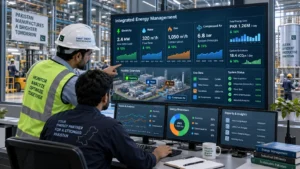
A useful EMS should make it easier to evaluate consumption over time, compare departments or production lines, examine peak demand, understand baseload, identify abnormal consumption, compare energy performance against relevant baselines, and create meaningful Energy Performance Indicators.
Production context becomes particularly important here.
Suppose Line A consumed more electricity this month than last month. That does not automatically mean performance became worse. Production may also have increased substantially.
Instead of looking only at total kWh, the facility may need to monitor energy intensity such as kWh per tonne, kWh per unit, kWh per batch, or another production-relevant metric.
The same principle applies to utilities.
An effective system should increasingly help the business answer not only how much energy was consumed, but whether that amount was appropriate for the operating conditions.
That is where energy monitoring begins turning into energy management.
Local Presence Does Not Replace Technical Capability
When searching for an energy management company near you, location should therefore be treated as one selection criterion rather than the entire decision.
A provider may be geographically close but have limited industrial integration capability. Another may offer excellent software but depend heavily on remote technical support. A third may understand electrical systems but provide little ongoing analytics after installation.
The right company needs a combination of engineering and operational capability.
Management should understand who will conduct the site assessment, who designs the metering architecture, who installs and commissions the system, who configures the software, who verifies measurement accuracy, who trains the internal team, and who provides support after deployment.
It is also reasonable to ask about relevant industrial experience.
A company that has only worked with commercial buildings may approach energy management differently from one accustomed to factories with large motors, production lines, boilers, compressors, process utilities, PLCs, VFDs, and industrial communication systems.
The goal is not necessarily to find a provider that has previously worked on an identical factory. It is to determine whether the engineering team understands industrial energy flows well enough to adapt the system to your environment.
Energy Audits, EMS and Energy Services Should Connect
Businesses should also consider whether the provider can support energy improvement beyond installing monitoring hardware.
Pakistan’s National Energy Efficiency and Conservation Authority maintains information on Energy Auditing Firms, Energy Conservation Solution Providers, and Energy Service Companies, reflecting the broader role that engineering and energy-service providers can play in efficiency projects. NEECA describes ESCO-type services as including analysis, solution design, implementation, and ongoing support around energy-saving projects.
This distinction matters because measurement alone does not reduce an energy bill.
The organization must identify the cause of inefficient performance and take action.
An EMS may show excessive non-production consumption. An audit may reveal which equipment is responsible. Engineering analysis may identify a compressed-air leak, oversized motor, inefficient control strategy, poor sequencing, unnecessary operating pressure, heat loss, inappropriate HVAC settings, or another issue.
After corrective action, the monitoring system can then help verify whether performance actually improved.
That creates a more useful cycle:
Measure → Identify → Improve → Verify → Continue Monitoring
A company capable of supporting that cycle can create substantially more value than a provider that considers the project complete once the meters and dashboard are online.
Ask About Ownership, Scalability and Long-Term Support
An EMS should be designed for the facility you operate today without becoming a barrier to what the facility may need tomorrow.
A factory may initially monitor the main incomer, transformers, major production feeders, compressors, and chillers. Six months later, management may want machine-level monitoring on a specific production line. Another year later, a new building, solar plant, boiler, or production area may be added.
The system should be capable of expanding without requiring the organization to rebuild the entire architecture.
Businesses should also understand what happens to their data.
Can historical data be exported? Who owns it? What happens if the organization changes its service arrangement? Can the system integrate additional equipment or platforms later? Are commonly used industrial protocols supported? What happens if connectivity is temporarily interrupted? Who maintains gateways, meters, or software configurations?
These questions may seem less exciting than dashboard design during the procurement stage, but they become much more important once an EMS has been operating for several years.
Cost Should Be Evaluated Against Scope, Not Just Quotation Value
Two Energy Management System proposals can have very different prices while appearing superficially similar.
One may monitor only main electrical feeders. Another may include machine-level sub-metering, compressed-air flow, gas, water, communication gateways, integration with existing controllers, software configuration, commissioning, analytics, training, and ongoing support.
Comparing only the final quotation figure therefore creates a misleading picture.
Management should compare scope.
How many meaningful measurement points are included? Which utilities are covered? What installation work is required? Are existing meters being integrated? Are gateways included? Is commissioning included? Are reports and analytics included? What support is available after deployment?
The cheapest proposal is not necessarily poor, and the most expensive proposal is not automatically better.
The stronger proposal is the one that creates sufficient visibility to support decisions without adding unnecessary instrumentation or complexity.
How Daitan Solutions Approaches Energy Management in Pakistan
Daitan Solutions works with Pakistani factories and facilities across energy management, industrial IoT, energy audits, utility monitoring, ESG assessment, and related industrial engineering areas. Its current EMS offering is positioned around tracking energy and utilities from facility level toward individual machines, while its energy-audit work focuses on identifying inefficiencies, improvement opportunities, investment requirements, and verification after implementation.
For organizations searching for an energy management company near them, the starting point should therefore be the facility itself.
The right EMS scope depends on where energy is entering the site, which systems consume it, what instrumentation already exists, which utilities matter most, and what management wants to improve.
A textile mill may need a completely different architecture from a pharmaceutical plant. A factory with extensive PLC and SCADA infrastructure may be able to reuse large amounts of existing data. Another facility may need additional smart meters, current transformers, flow meters, pressure sensors, or industrial communication gateways before useful analytics are possible.
Daitan’s approach is to connect the engineering and monitoring layers rather than treating the EMS as a standalone dashboard.
Final Thoughts
Finding an energy management company near you in Pakistan should not be reduced to selecting the nearest vendor on a map.
Local presence matters because industrial energy-management projects require interaction with the physical facility. Site surveys, installation, integration, commissioning, troubleshooting, training, and after-sales support all benefit from engineering resources that can work directly with the plant.
But proximity should support technical capability, not replace it.
The right energy management company should be able to understand your facility before proposing a solution, identify meaningful measurement points, integrate existing equipment where practical, monitor the utilities that actually matter, convert raw consumption into useful performance information, and remain involved as the system evolves.
Ultimately, an Energy Management System should help your organization answer increasingly useful questions.
Where is energy being consumed? Which systems are responsible for changes? Is consumption reasonable for the current production level? Where is waste occurring? Which improvement should receive priority? Did the corrective action actually work?
If the system can answer those questions reliably, it is doing much more than putting your electricity bill on a dashboard.
Find the Right Energy Management Solution With Daitan Solutions
Daitan Solutions helps factories and facilities across Pakistan assess their energy requirements and develop Energy Management Systems around actual operating conditions. From energy audits and smart metering to industrial IoT integration, multi-utility monitoring, analytics, and ongoing engineering support, the objective is to create visibility that leads to measurable operational decisions.
If your organization is searching for an energy management company near you in Pakistan, the next step should be a discussion about your facility, not simply a software demonstration.
Visit Daitan Solutions to discuss your facility’s Energy Management System, energy audit, utility monitoring, and industrial energy-management requirements.