
Compressed air is often called the fourth utility in a factory, after electricity, gas, and water. It is also the most wasteful one, and the waste is almost always invisible. A leak in a compressed air line does not trip a breaker, does not show up as a spike anyone notices, and does not stop production. It just runs quietly in the background, adding cost to every single electricity bill until someone goes looking for it.
This blog walks through why compressed air leaks are so expensive, how to actually calculate what they are costing a facility, and what a proper leak detection and repair program looks like.
1. Why Compressed Air Is So Expensive to Waste
Generating compressed air is one of the least efficient conversions of electricity into usable work anywhere in a typical factory. Only around 10 to 15 percent of the electrical energy a compressor consumes ends up as useful pneumatic work. The rest is lost as heat during compression. That means every cubic foot of compressed air that escapes through a leak represents electricity that was already paid for in full, at a poor conversion rate, and then thrown away before it did anything useful at all.
Electricity is not a small part of what compressed air costs over its lifetime either. It typically accounts for around three quarters of a compressed air system’s total lifecycle cost, once the purchase price of the compressor is set against ten to fifteen years of continuous running. The compressor itself is a one time expense. The electricity bill runs every single month for the life of the equipment.
2. How Much Air Pakistani Factories Are Actually Losing
Across thousands of industrial compressed air systems studied by the US Department of Energy, leaks alone account for 20 to 30 percent of total compressor output in a typical, reasonably maintained plant. In systems that have never had a dedicated leak survey, that number climbs higher. World class facilities that run active leak detection and repair programs maintain leak rates closer to 5 to 10 percent. Most factories can realistically get down to 10 to 15 percent with a systematic survey, without any major capital investment.
The gap between an unmanaged system and a well managed one is not small. On a typical rotary screw compressor, every 1 percent reduction in leak rate saves roughly 1 percent of the total energy cost of running that system, which on a large compressed air installation adds up fast.
3. What a Single Leak Actually Costs
The standard formula used to calculate the cost of a compressed air leak comes from the US Department of Energy’s compressed air program:
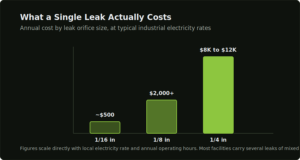
Most rotary screw compressors running at 100 PSI use somewhere between 18 and 22 kW to produce 100 CFM of compressed air, so a reasonable planning figure is roughly 0.20 kW per CFM. Using that figure, the size of the leak orifice makes a dramatic difference to the annual cost:
| Leak Orifice Size | Approximate Air Loss | Typical Annual Cost |
|---|---|---|
| 1/16 inch | Roughly 6 CFM | Several hundred dollars equivalent |
| 1/8 inch | Roughly 25 CFM | Over $2,000 equivalent |
| 1/4 inch | Roughly 100 CFM | $8,000 to $12,000 equivalent |
These figures scale directly with local electricity rates, and industrial tariffs in Pakistan sit well within the range these benchmarks are built on, so the same order of magnitude applies. A single quarter inch leak left unrepaired for a year is rarely a minor maintenance item. It is a recurring cost close to what a proper leak detection survey for the entire facility would cost to run in the first place.
4. Where Leaks Actually Happen
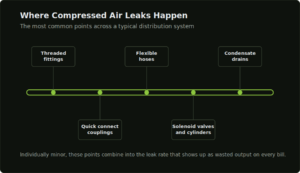
Compressed air leaks concentrate in a small number of predictable locations across almost every facility:
- Threaded fittings and pipe joints, especially where thread sealant has degraded over time or where vibration has loosened a connection
- Quick connect couplings at hose ends, which wear internally with repeated connection and disconnection
- Flexible hoses, particularly where they flex repeatedly near a tool or machine
- Solenoid valves and cylinders on pneumatic equipment, where internal seals wear out gradually rather than failing all at once
- Condensate drains that fail to seal properly after clearing moisture from the line
- Old or poorly maintained shutoff valves on sections of the plant that are not in continuous use
None of these individually look like a major problem. A plant with dozens of small leaks scattered across these points, which describes most facilities that have never run a dedicated survey, ends up with a leak rate that adds up to the equivalent of several large holes in the system.
5. Why Leaks Go Unnoticed for Years
Human hearing can pick up a leak if it is large enough and the surrounding area is quiet enough, generally leaks above 1 CFM at close range. In a working factory floor with machinery running, most leaks are well below the threshold anyone can hear by walking past. That is the core problem: the leaks costing the most money over a year are frequently the ones nobody in the building has ever consciously noticed.
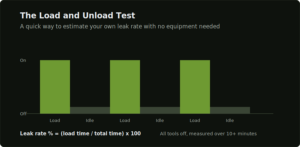
A simple way to estimate your own leak rate: Run a load and unload test. With all pneumatic tools and equipment switched off, measure how long the compressor runs to maintain pressure over a ten minute period. Leak rate as a percentage is roughly the load time divided by total time, multiplied by 100. If the compressor is cycling on for four out of every ten minutes with nothing drawing air, the system is losing close to 40 percent of its output to leaks alone.
6. Ultrasonic Leak Detection
Compressed air leaks generate high frequency turbulence as air escapes through a small opening, well above the range of human hearing. Ultrasonic leak detectors pick up this turbulence directly, allowing a technician to walk a facility and pinpoint leaks precisely, including ones far too small to hear, even during normal working hours with machinery running in the background.
A proper ultrasonic survey typically identifies leaks at every major joint, valve, and fitting across a facility, tags each one by severity, and gives a maintenance team a prioritized repair list ranked by cost impact rather than a vague sense that “the system probably has some leaks somewhere.”
7. Pressure Drop as an Early Warning Sign
A compressed air system with a growing leak problem shows a specific symptom before anyone finds the leak itself: falling line pressure at the point of use, forcing operators to raise compressor set pressure to compensate. Every additional 2 PSI of system pressure increases energy consumption by roughly 1 percent, which means chasing pressure loss by simply running the compressor harder is treating the symptom while paying twice, once for the leak and again for the extra pressure needed to work around it.
8. Why a One Time Fix Is Not Enough
Leak rates do not stay fixed once a repair program is completed. New leaks develop constantly as fittings loosen, hoses age, and seals wear down. A facility that runs a leak survey once, fixes everything found, and never checks again will typically see the leak rate climb back toward its original level within a year or two. Compressed air leak management works as an ongoing program, not a single project, which is why the facilities with the lowest leak rates are the ones with recurring surveys built into their maintenance calendar rather than a one off exercise.
9. Continuous Monitoring Versus Periodic Surveys
Periodic ultrasonic surveys, run once or twice a year, catch the leaks that exist at the moment of the survey. They do not catch a fitting that starts leaking the week after the survey team leaves. Facilities that install continuous flow monitoring on their compressed air lines can see total consumption drift upward in near real time, well before it shows up as a mystery increase on the electricity bill three months later, and well before anyone would have scheduled the next manual survey.
Flow meters positioned at key distribution points let a facility separate genuine production demand from baseline consumption that should be near zero during off hours or weekends. A baseline reading that never drops to zero overnight is one of the clearest, simplest signals that a facility has active leaks costing money around the clock, whether or not the plant is even running.
10. Building the Business Case for a Leak Program
Getting budget approved for a leak detection and repair program is usually easier than facility managers expect, because the numbers translate directly into finance language. Instead of a general statement that leaks should probably be fixed, a proper survey produces a specific figure: the current leak rate is costing a defined amount per year, and a repair program costing a fraction of that recovers its cost within months rather than years. Most leak repair programs pay for themselves within a single year, frequently much faster, since the labor and materials needed to fix a fitting or replace a hose are minor compared to a year of electricity wasted through it.
11. Compressed Air Efficiency Beyond Leaks
Leak repair is usually the fastest payback item, but it sits inside a wider set of compressed air efficiency issues worth addressing at the same time, including right sizing compressors to actual demand rather than peak nameplate capacity, recovering compressor heat for space or water heating since over 90 percent of the electricity a compressor consumes is ultimately released as heat, and reviewing whether system pressure has crept upward over time to compensate for leaks rather than genuine process requirements. A facility auditing compressed air leaks is well positioned to catch these related issues in the same exercise instead of treating each one as a separate project months apart.
12. How Daitan Solutions Helps
Daitan Solutions works with industrial facilities across Pakistan to measure actual compressed air consumption, identify where it is being lost, and keep it monitored so leak rates do not quietly climb back up after the first repair round. This includes flow metering at compressor output and key distribution points to establish a real baseline, integration with Daitan’s Energy Management System so compressed air consumption sits on the same dashboard as electricity, water, and gas, and ongoing visibility that flags abnormal baseline consumption before it turns into a surprise on next month’s bill.
Find out what your leaks are actually costing
Daitan Solutions can measure your facility’s real compressed air consumption and help you build a leak detection and monitoring program that pays for itself.
13. Frequently Asked Questions
How much of a factory’s compressed air is typically lost to leaks?
Studies of thousands of industrial systems put typical leak losses at 20 to 30 percent of total compressor output in a reasonably maintained plant. Facilities that have never run a dedicated leak survey are often well above that range, while world class facilities with active detection programs maintain leak rates closer to 5 to 10 percent.
Can you hear a compressed air leak?
Only the larger ones. A leak needs to be roughly 1 CFM or larger to be audible while walking past it in a working factory environment. Most of the leaks contributing the most to annual cost across a facility are too small to hear and require ultrasonic detection equipment to locate.
What does a single compressed air leak actually cost per year?
It depends heavily on size. A small 1/16 inch leak might cost a few hundred dollars equivalent per year, while a 1/4 inch leak can cost $8,000 to $12,000 equivalent annually at typical industrial electricity rates and continuous operation. Most facilities have multiple leaks of varying sizes running simultaneously.
How often should a compressed air leak survey be repeated?
Leak rates climb back up over time as fittings loosen and seals wear, so a one time survey is not sufficient on its own. Facilities with the lowest sustained leak rates typically run surveys once or twice a year and increasingly pair that with continuous flow monitoring to catch new leaks between scheduled surveys.
How quickly does a leak repair program pay for itself?
Most leak detection and repair programs pay for themselves within a single year, often faster, since the cost of locating and fixing leaks is typically small compared to a year of the electricity being wasted through them.
14. The Bottom Line
Compressed air leaks are one of the few inefficiencies in a factory that cost real money every single day without ever showing up as a visible problem. There is no alarm, no downtime, and no obvious signal beyond a bill that is slightly higher than it should be, month after month. Finding the leaks takes a proper survey. Keeping the leak rate down after that takes ongoing monitoring rather than a one time fix. Both are considerably cheaper than another year of paying to compress air that never does any work at all.