
ESG has become a standing item in most sourcing conversations, but for many Pakistani manufacturers it still shows up as a vague requirement rather than a concrete process. A buyer’s sustainability questionnaire arrives, or a certification body asks for emissions data, and the honest answer inside the factory is often that nobody is entirely sure what data exists, where it lives, or whether it would hold up if someone actually checked it.
An ESG assessment exists to close exactly that gap. This article walks through what actually happens during a Daitan ESG assessment, from the first data pull to the final report, so the process is clear before you commit budget or time to it.
1. What an ESG Assessment Is Actually For
An ESG assessment identifies risks and opportunities across a facility’s environmental, social, and governance performance, not as an abstract exercise, but as groundwork for two very practical outcomes: passing the scrutiny of buyers who now expect measured data rather than a general sustainability statement, and building a factual baseline a company can actually improve against over time. The assessment is not the same thing as a certification. It is the structured data collection and analysis that makes a credible certification, report, or buyer submission possible in the first place.
2. Why Utility Data Sits at the Center of It
The environmental pillar of any ESG framework is only as credible as the data behind it, and for a manufacturing facility, that data is fundamentally utility data: how much electricity is consumed and from what source, how much water is used and where it goes, how much fuel is burned on site, and what emissions result from all of it. Without accurate, verified consumption figures, an ESG report is essentially a narrative with no numbers to check it against, which is precisely the kind of submission buyers have grown skeptical of.
This is why an ESG assessment does not start with a questionnaire. It starts with the same kind of measured data an energy audit or an EMS deployment would collect, electricity, water, and compressed air consumption at the plant and, where relevant, the equipment level.
3. The Assessment Process Step by Step
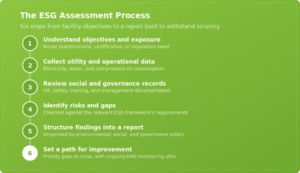
- Understand the facility’s objectives and exposure. The assessment starts by establishing why the facility needs ESG data in the first place, a specific buyer’s questionnaire, a certification target, an investor requirement, or a regulatory disclosure, since this shapes which frameworks and categories the assessment needs to align with.
- Collect utility and operational data. Electricity, water, and compressed air consumption are pulled from existing meters, bills, or a live EMS where one is already deployed. Where metering gaps exist, this stage identifies them, since a data gap discovered here is far cheaper to fix than one discovered during a buyer audit.
- Review social and governance documentation. Alongside environmental data, the assessment reviews existing HR, safety, and governance records, worker policies, safety training logs, compliance certificates, and management systems, since ESG frameworks weight all three pillars, not environmental data alone.
- Identify risks and gaps. The collected data and documentation are checked against the relevant framework’s requirements to flag where the facility currently falls short, whether that is a missing emissions calculation, an undocumented safety policy, or a governance structure that has never been formally recorded.
- Structure the findings into a report. The final deliverable organizes environmental, social, and governance findings into a format aligned with recognized frameworks, giving the facility a report that can be handed to a buyer, used to prepare for certification, or kept as an internal baseline to track improvement against.
- Set a path for improvement. Because the assessment identifies specific gaps rather than a single pass or fail outcome, it comes with a clear next step, which gaps to close first, and how ongoing EMS monitoring keeps the underlying data current rather than static from the day of the assessment.
4. What the Final Report Actually Contains
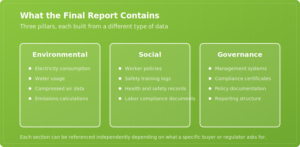
A completed ESG assessment report typically brings together verified consumption and emissions data on the environmental side, a review of labor and safety documentation on the social side, and an evaluation of management systems and policies on the governance side, structured so that each section can be referenced independently depending on what a specific buyer or regulator is asking for. This structure matters because different buyers request different subsets of ESG information, and a well organized report lets a facility respond to a specific ask without rebuilding the analysis each time.
Why buyers reject unverified claims: A written statement that a facility is “committed to sustainability” carries no weight on its own. What buyers increasingly check for is whether that statement is backed by measured data, electricity and water consumption figures, emissions calculations, documented safety practices, that could hold up if they asked to see the underlying numbers.
5. How This Differs From an Energy Audit
It is worth being clear about where an ESG assessment and an energy audit overlap and where they differ, since both involve utility data and both feed into sustainability goals. An energy audit is focused specifically on identifying energy inefficiencies and cost saving opportunities within the facility’s systems and equipment. An ESG assessment uses similar underlying data but applies it more broadly, across environmental, social, and governance categories, with the explicit goal of producing a report structured for external reporting or buyer verification rather than an internal efficiency improvement plan. In practice, the two are complementary. Energy audit findings frequently feed directly into the environmental section of an ESG assessment rather than requiring the data to be collected twice.
6. Why a One Time Assessment Is Not the End Point
An ESG assessment produces a report based on data collected at a specific point in time, but a facility’s actual performance keeps moving after that report is delivered. Consumption patterns shift, new equipment gets installed, policies get updated or lapse. A report that is accurate on delivery day but never refreshed becomes exactly the kind of stale, unverifiable claim buyers have grown wary of. This is why an ESG assessment works best paired with ongoing EMS monitoring, so the environmental data underlying future reports stays current rather than requiring a full data collection exercise to be repeated from scratch each time a buyer asks.
7. Who Actually Needs This
ESG assessments are most immediately relevant for export oriented manufacturers, particularly in textile, apparel, and other sectors facing recurring buyer sustainability questionnaires or third party compliance audits, but the same underlying data also supports facilities pursuing green financing, preparing for future regulatory disclosure requirements, or simply looking to establish a factual baseline before setting internal sustainability targets. In all of these cases, the common requirement is the same: verified data, not a general statement of intent.
8. How Daitan Solutions Helps
Daitan Solutions runs ESG assessments for manufacturing facilities across Pakistan, built on the same utility monitoring infrastructure used in its energy audit and EMS work, so environmental data does not need to be collected separately from scratch. This includes identifying data gaps and metering needs early in the process, reviewing social and governance documentation alongside environmental data, and structuring the final report so it stands up to buyer verification and lays out a clear path toward closing whatever gaps the assessment identifies.
Get an ESG report your buyers can actually verify
Daitan Solutions can assess your facility’s environmental, social, and governance data and structure it into a report built to withstand scrutiny.
9. Frequently Asked Questions
How long does an ESG assessment take?
Timelines depend on facility size and how much utility data already exists in a usable form. Facilities with an existing EMS or recent energy audit generally move faster, since much of the underlying environmental data is already collected, while facilities starting from scratch need additional time for initial data gathering and metering gap identification.
Is an ESG assessment the same as certification?
No. An ESG assessment is the structured data collection and analysis process that produces a credible report. Certification is a separate step, typically involving a third party body verifying the facility against a specific standard, that a strong ESG assessment makes considerably easier to pursue.
Do we need an energy audit before an ESG assessment?
Not strictly, but it helps. An energy audit generates verified consumption data and emissions calculations that feed directly into the environmental section of an ESG assessment, so facilities that have already completed one typically move through the ESG assessment faster with less duplicate data collection.
What happens if the assessment finds gaps we cannot immediately fix?
That is a normal and expected outcome. The assessment is designed to identify gaps clearly and prioritize them, not to require every issue resolved before the report is useful. Many buyers and frameworks look favorably on a facility that can demonstrate an active improvement plan, not just a finished result.
Does the ESG report stay valid indefinitely once completed?
No. It reflects data at the time it was collected, and consumption patterns, equipment, and policies change afterward. Facilities are generally better served pairing the assessment with ongoing EMS monitoring so the underlying data stays current rather than needing a full re-collection exercise each time it is requested.
10. The Bottom Line
The gap between a factory that says it is sustainable and one that can prove it is almost entirely a data gap. An ESG assessment closes that gap methodically, starting with the same measured utility data an energy audit relies on, extending it across social and governance categories, and structuring the result into a report built to survive the kind of scrutiny buyers and regulators are increasingly applying. The facilities that treat this as an ongoing practice, rather than a one time document produced under deadline pressure, are the ones whose sustainability claims actually hold up when someone asks to see the numbers.