
Most industrial facility managers in Pakistan check three numbers on their electricity bill: units consumed, peak demand, and the fixed charge. Almost nobody checks the power factor line. That single overlooked figure quietly adds a surcharge that can run into hundreds of thousands of rupees a year, and the equipment needed to eliminate it usually pays for itself within two years.
This article breaks down exactly how DISCOs in Pakistan calculate the power factor penalty, why so many factories carry it without realizing it, and what it actually takes to fix it for good.
1. What Power Factor Actually Means
Every industrial connection draws two kinds of power. Real power, measured in kW, is what actually does work: turning motors, running compressors, powering lights. Reactive power, measured in kVAR, does no useful work but is still needed to maintain the magnetic fields inside inductive equipment like motors, transformers, and welding machines.
Power factor is the ratio between the two. It tells you how efficiently your facility converts the electricity it draws into usable work.
A power factor of 1.0 means every unit of electricity supplied is doing useful work. A power factor of 0.75 means a quarter of what the utility is generating and delivering to your facility is reactive load that never turns a single motor shaft. The utility still has to size its cables, transformers, and generation capacity for that extra load, and it recovers that cost from you directly.
2. How DISCOs in Pakistan Penalize Low Power Factor
Every distribution company in Pakistan, including K-Electric, LESCO, GEPCO, FESCO, MEPCO, and HESCO, sets a minimum acceptable power factor in its industrial tariff, typically 0.90 lagging. Fall below that threshold and the penalty structure kicks in automatically, calculated from the meter’s recorded kVARh alongside kWh.
The typical structure applied across Pakistani DISCO tariffs works like this:
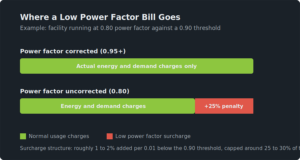
- A surcharge of roughly 1 to 2 percent is added to the bill for every 0.01 the power factor falls below the 0.90 threshold
- In facilities with consistently poor power factor, this can compound to 25 to 30 percent of the total bill
- The penalty is recalculated every billing cycle, so it is not a one time hit, it repeats every month until corrected
Because the surcharge is folded into the total bill rather than itemized clearly, most facility managers never isolate what portion of their monthly cost is pure penalty rather than actual consumption.
3. What This Actually Costs on a Real Bill
To put this in context, industrial energy tariffs notified for 2026 give a sense of the base rates a poor power factor penalty is being calculated on top of:
| Category | Energy Charge (Rs/unit) | Peak Rate | Off Peak Rate |
|---|---|---|---|
| B1 (up to 25 kW) | 26.23 | 35.74 | 25.48 |
| B3 (11 to 33 kV) | 27.00 | 35.68 | 23.67 |
| B4 (66 to 132 kV) | 26.43 | 35.68 | 23.38 |
Fixed charges of Rs 1,250 per kW per month apply on top of these rates. For a mid sized factory with a 500 kW connection running a power factor around 0.80, a 20 to 25 percent surcharge on a bill of several million rupees a month is not a rounding error. It is often larger than what the same facility would spend on the correction equipment needed to eliminate the charge entirely.
4. Why Pakistani Factories Struggle With Poor Power Factor
Low power factor is rarely caused by one single issue. It usually builds up from a combination of:
Induction motors running underloaded
A motor running at 30 to 40 percent of rated load draws almost as much reactive power as one running near full load, while producing far less useful output. Oversized motors selected with excess safety margin are common across Pakistani plants and are one of the biggest silent contributors.
Old motors and transformers
Rewound or aging motors and transformers lose magnetic efficiency over time, drawing more reactive current for the same mechanical output.
Fluorescent lighting and welding equipment
Older ballast based lighting and arc welding equipment are both heavily inductive loads that drag power factor down disproportionately to their actual energy use.
No power factor correction installed at all
Many smaller and mid sized industrial units in Pakistan were never fitted with capacitor banks at the time of installation, and the penalty has simply been absorbed into operating cost ever since without anyone flagging it as fixable.
5. How to Spot the Penalty on Your Own Bill
The power factor figure is usually printed on the DISCO bill as a percentage or a decimal, sometimes labeled PF, cos phi, or power factor surcharge. If it reads below 0.90, or if there is a separate line item for a low power factor surcharge, the facility is paying for reactive power it does not need to be paying for.
Quick check: If your facility’s power factor has never been discussed by your electrical team or mentioned by your DISCO relationship manager, it is worth pulling the last six months of bills and checking the recorded PF value. Most facilities that have never installed correction equipment sit somewhere between 0.70 and 0.85.
6. The Fix: Power Factor Correction Explained
Power factor correction works by installing capacitor banks that supply reactive power locally, at the point where it is consumed, instead of drawing it from the grid. This reduces the reactive component the DISCO meter records, pushing the power factor back above the penalty threshold.
The required capacitor size is calculated using the difference between the existing and target power factor:
Where P is the real power in kW, phi1 is the phase angle corresponding to the existing power factor, and phi2 is the phase angle corresponding to the target power factor. Most correction projects in Pakistan target a final power factor between 0.95 and 0.99, comfortably clear of the DISCO penalty threshold without overcorrecting.
7. Automatic Versus Fixed Capacitor Banks
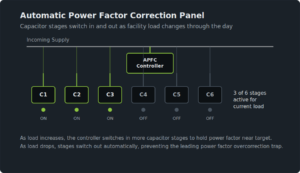
Fixed capacitor banks supply a constant amount of reactive compensation regardless of how the facility’s load changes through the day. They work reasonably well for facilities with a stable, unchanging load profile, but most industrial plants do not run that way. Load shifts between shifts, production lines start and stop, and seasonal changes affect HVAC and compressor demand.
Automatic power factor correction panels solve this by switching capacitor stages in and out as load changes, typically in 6 to 12 steps, keeping the power factor close to target continuously rather than only at peak load. For facilities with variable load, an automatic panel is the standard specification, since a fixed bank sized for peak load will overcorrect during lighter load periods.
8. The Leading Power Factor Trap
Overcorrection is a real risk, not just a theoretical one. An oversized fixed capacitor bank can push power factor into a leading, or capacitive, condition during periods when the facility’s actual load drops. Most Pakistani DISCO tariffs also penalize a leading power factor, and it can additionally cause voltage rise problems on the internal electrical network. This is the main reason automatic panels are specified for any facility with a load profile that changes meaningfully across the day.
9. Harmonics and Detuning Reactors
Facilities with a significant amount of variable frequency drives, UPS systems, or other non linear loads generate harmonic distortion on the electrical network. Installing a plain capacitor bank into a harmonic rich environment can cause resonance, which amplifies rather than reduces electrical problems. In these cases, detuned capacitor banks with reactors tuned to standard frequencies such as 134 Hz or 189 Hz are used instead, avoiding resonance with the dominant harmonic orders typically present in industrial supplies. Correction equipment for any facility with significant VFD or UPS load should always be specified with harmonic conditions in mind, not just the power factor number alone.
10. Why You Cannot Fix What You Are Not Measuring
Sizing a capacitor bank correctly, and keeping it correctly sized as load changes over time, depends entirely on accurate, ongoing measurement of kW, kVAR, and kVA at the point of connection. A one time reading from the DISCO meter tells you where the facility stood on one day, not how it behaves across shifts, seasons, or production changes.
This is where a facility benefits from combining power factor correction with continuous monitoring rather than treating it as a single installation project. A properly instrumented facility can see power factor drift in real time, catch a failing capacitor stage before the penalty reappears on the bill, and confirm the corrected power factor is holding steady month over month rather than assuming it still is.
11. Return on Investment for Power Factor Correction
Capacitor bank projects are among the fastest paying back investments available to an industrial facility in Pakistan, largely because the penalty being eliminated is a recurring monthly cost rather than a one time inefficiency. Typical payback periods for a properly sized capacitor bank installation fall between 12 and 24 months, after which the eliminated surcharge is pure savings for the remaining service life of the equipment, which commonly runs well beyond a decade with proper maintenance.
12. Power Factor Correction Fits Into a Larger Energy Strategy
Power factor correction is rarely the only inefficiency sitting inside an industrial facility’s electricity bill. It is common to find it alongside compressed air leaks, underloaded motors, and poor load scheduling, all of which show up during a structured energy audit rather than a standalone power factor check. Facilities that treat power factor correction as one part of a broader audit and monitoring program tend to catch these overlapping issues together instead of fixing one cost driver while several others continue running unnoticed.
13. How Daitan Solutions Helps
Daitan Solutions works with industrial facilities across Pakistan to measure, correct, and continuously monitor power factor as part of a wider energy management approach. This includes on site measurement using power quality analyzers to establish the actual existing power factor and load profile, engineering the correct capacitor bank sizing and configuration for the facility’s specific load behavior, and integrating the correction system with Daitan’s Energy Management System so power factor, along with electricity, water, and compressed air usage, is visible on one dashboard rather than discovered again on next month’s bill.
Stop paying a penalty you can eliminate
Daitan Solutions can measure your facility’s actual power factor, size the right correction system, and keep it monitored so the surcharge does not quietly return.
14. Frequently Asked Questions
What is a good power factor for an industrial facility in Pakistan?
Most DISCOs set the minimum acceptable power factor at 0.90 lagging. Correction projects typically target a final power factor between 0.95 and 0.99, which keeps the facility clear of the penalty threshold with some margin for load variation.
How is the power factor penalty calculated on a K-Electric or DISCO bill?
The penalty is generally applied as a surcharge of roughly 1 to 2 percent of the bill for every 0.01 the recorded power factor falls below the 0.90 threshold, and it can add up to 25 to 30 percent to the total bill in facilities with consistently poor power factor.
Can a capacitor bank cause problems if it is oversized?
Yes. An oversized or incorrectly sized fixed capacitor bank can push the facility into a leading power factor during periods of lower load, which most DISCO tariffs also penalize, and can cause voltage rise issues on the internal network. This is why automatic panels with multiple switching stages are used for facilities with variable load.
How long does it take to recover the cost of power factor correction equipment?
Typical payback periods for a properly sized capacitor bank installation in Pakistan fall between 12 and 24 months, based on eliminating the recurring monthly penalty alone.
Does power factor correction help with harmonics too?
Not directly. Facilities with significant variable frequency drive or UPS load need detuned capacitor banks with reactors tuned to specific frequencies to avoid resonance with existing harmonics, rather than a standard capacitor bank alone.
15. The Bottom Line
Power factor is one of the few line items on an industrial electricity bill in Pakistan where the fix costs less than a year or two of the problem it eliminates, and yet it remains one of the least discussed. Checking where your facility currently stands takes a single look at the last few months of DISCO bills. Fixing it, correctly and permanently, takes proper measurement, correctly sized equipment, and ongoing monitoring to make sure it stays fixed.