Most conversations about industrial power quality talk about it as a cost issue: wasted energy, inflated bills, equipment running less efficiently than it should. In a textile mill, poor power quality does all of that, but it also does something else that rarely gets the same attention, it shows up directly in the product. A voltage dip that lasts a fraction of a second can snap a yarn, throw off thread tension, or leave a visible shading flaw in finished fabric, defects a customer will actually see and reject.
This article looks at the specific power quality problems that hit textile production harder than most other industries, and why a spinning or weaving floor needs its own approach rather than a generic industrial power quality checklist.
1. Why Textile Floors Are Especially Exposed
Electric motors are everywhere in a textile mill, and across many industries, motor load can account for up to 80 percent of total facility electrical demand. A textile floor compounds this with a specific pattern: dozens or hundreds of induction motors on spinning frames, looms, and auxiliary equipment, many starting and stopping across a shift, combined with an increasing share of variable frequency drives on modern spinning, texturizing, and dyeing machinery. This combination, heavy motor load plus a growing base of power electronics, is exactly the mix that generates and is simultaneously most sensitive to the two power quality problems that matter most here: voltage sags and harmonic distortion.
2. Voltage Sags: The Most Common Disturbance, and the Most Damaging Here
A voltage sag is a short-duration drop in RMS voltage, commonly defined as at least a 10 percent reduction lasting from half a cycle up to a minute, and it is consistently identified as the most common power quality disturbance industrial facilities experience. Industry studies have found average industrial customers experience roughly 66 voltage sags a year, and across industrial customers generally, power quality events, sags chief among them, can disrupt a process as many as 20 to 30 times annually.
The most common cause in a factory setting is exactly what a textile floor has in abundance: motors starting. Large induction motors draw significantly more current at start-up than during normal running, and that inrush current pulls voltage down momentarily across the local electrical network, an effect that becomes more pronounced when several motors start in close succession, common during shift changes or after a planned stoppage.
3. What a Sag Actually Does to Production, Not Just the Bill
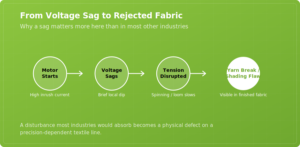
In most industrial settings, a brief voltage sag might reset a controller or trip a non critical process. In textile production, the consequences are more visible and more expensive per incident. Sudden voltage drops slow down spinning frames and electronic systems controlling thread tension, causing frequent yarn snaps, uneven thread tension, and visible fabric shading flaws, exactly the kind of defect that shows up in finished product and gets rejected downstream. A sag can also cause motor loads to stop or restart unexpectedly, reset digital control devices with loss of process data, and in more severe cases contribute to equipment damage or material spoilage mid-run.
Why this is worse in textile than in many other industries: A sag that trips a non-precision process elsewhere might just cause a brief pause. On a spinning frame or an electronic jacquard loom, the same sag can leave a physical, visible defect embedded in material that is already partway through an expensive, time-consuming production run.
4. Harmonics: A Problem the Mill Itself Is Increasingly Creating
Harmonic distortion is the distortion of the voltage or current waveform away from a clean sine wave, caused by non-linear loads, equipment that draws current in a way that does not track the voltage waveform smoothly. Variable frequency drives, increasingly common on modern textile machinery for exactly the energy-saving reasons covered in our piece on VFD retrofits, are a leading source of this distortion, alongside saturation effects in the magnetic cores of the mill’s many induction motors themselves.
Left unmanaged, harmonic distortion causes real, measurable damage over time: excess heating in motors, transformers, and neutral conductors, reduced equipment lifespan, and in some cases nuisance tripping of the very VFDs that introduced the distortion in the first place, since drives are particularly sensitive to voltage disturbances and are commonly programmed to trip off when DC bus voltage drops below a set threshold.
5. The Self-Reinforcing Problem: More Efficiency Equipment, More Distortion Risk
There is a genuine tension worth naming here. VFDs are one of the most effective tools for reducing energy waste on pumps, fans, and increasingly on textile machinery itself, exactly the kind of upgrade covered elsewhere on this site. But VFDs are also a primary source of the harmonic distortion that, left unaddressed, can degrade power quality across the same facility and make the drives themselves more prone to nuisance tripping from voltage sags. This is not a reason to avoid VFDs, it is a reason to treat power quality management and efficiency upgrades as connected work rather than separate projects running independently of each other.
6. Why Textile Facilities Feel This More Than a Typical Warehouse or Office Building
Two factors make textile production disproportionately exposed compared to a facility running simpler equipment. First, the sheer density and diversity of motor load, spinning frames, ring frames, looms, winding machines, and dyeing equipment, all drawing current simultaneously and starting at different points across a shift, creates more frequent internal sag events than a facility with fewer, larger, less frequently cycled loads. Second, textile processes are precision-dependent in a way many other industries are not, thread tension, dye uptake, and fabric feed rates all depend on motors running at a consistent, predictable speed, which means the same voltage disturbance that a less precision-sensitive process would absorb without consequence shows up as a defect here.
7. Diagnosing the Problem Before Choosing a Fix
Voltage sags, harmonics, and other power quality issues often present as a mix of overlapping symptoms, unplanned downtime, nuisance trips, and inconsistent product quality, which makes it easy to misattribute the root cause. A proper power quality assessment involves monitoring voltage and current waveforms over time at key points in the facility, rather than assuming which specific disturbance is responsible based on symptoms alone. This is the same underlying principle covered in our piece on smart energy analyzers, accurate measurement at the right point in the system is what turns a vague pattern of production problems into a specific, addressable cause.
Energy Audit Services
Daitan Energy Management System
8. Common Mitigation Approaches
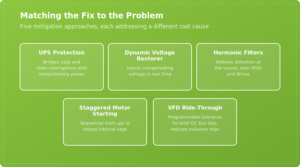
Once a specific power quality issue is properly diagnosed, several established mitigation approaches apply, matched to the specific problem rather than applied as a blanket fix:
- Uninterruptible power supplies (UPS) are the most common general solution for voltage sags, swells, and short interruptions, using stored battery energy to bridge the gap when incoming voltage falls outside an acceptable range, particularly valuable for protecting sensitive control electronics on precision equipment.
- Dynamic voltage restorers inject compensating voltage in real time to counteract a sag before it reaches sensitive equipment, a more targeted solution for facilities with frequent, disruptive sag events.
- Harmonic filters, passive or active, are specified to address distortion at its source, typically near VFDs and other significant non-linear loads, before that distortion propagates across the wider electrical system.
- Staggered motor starting, sequencing large motor start-ups rather than allowing them to start simultaneously, reduces the frequency and severity of internally generated sags, a low-cost operational fix worth reviewing before specifying new hardware.
- Ride-through programming on VFDs, using programmable parameters to allow a drive to tolerate a brief dip in DC bus voltage without tripping, reduces nuisance shutdowns without requiring additional hardware in some cases.
9. Power Quality as Part of a Broader Energy Strategy
Power quality issues rarely exist in isolation from the other electrical concerns already covered across this site. A facility dealing with frequent motor starts is often also managing power factor challenges from the same induction motors, and a facility installing VFDs for energy savings needs harmonic mitigation considered at the same time, not as an afterthought once nuisance trips start appearing. Treating power quality, power factor, and demand management as one connected assessment, rather than three separate investigations triggered by three separate complaints, is what actually resolves the underlying pattern rather than chasing each symptom individually.
10. How Daitan Solutions Helps
Daitan Solutions works with textile manufacturers across Pakistan to monitor and diagnose power quality issues at the points in the facility where they actually originate and cause damage, rather than guessing based on downstream symptoms. This includes power quality monitoring using Daitan’s Smart Energy Analyzer to capture voltage sags, harmonic distortion, and other disturbances with the resolution needed to identify root cause, recommendations for staggered motor starting, filtering, or UPS protection matched to the specific issue diagnosed, and integration of power quality data into Daitan’s Energy Management System so recurring disturbances are visible over time rather than rediscovered after every production quality complaint.
Stop guessing why your yarn is breaking
Daitan Solutions can diagnose the actual power quality issue behind recurring defects, trips, and downtime on your production floor.
11. Frequently Asked Questions
What is a voltage sag and why does it matter for textile production?
A voltage sag is a short-duration drop in voltage, typically caused by large motor starting or a network fault. In textile production, sags can slow spinning frames and disrupt electronic tension control systems, causing yarn breaks, uneven tension, and fabric shading defects, consequences more visible and costly than in many other industries.
Why do textile mills generate more power quality disturbances than other facilities?
Textile floors run a high density of induction motors, spinning frames, looms, and auxiliary equipment, many starting at different points across a shift, which creates frequent internal voltage sag events. The growing use of variable frequency drives on modern textile machinery also introduces harmonic distortion into the same system.
Do VFDs cause power quality problems or fix them?
Both, in different ways. VFDs reduce energy waste significantly on motor-driven equipment, but they are also a leading source of harmonic distortion, and they are particularly sensitive to voltage sags, since drives commonly trip off when DC bus voltage drops below a programmed threshold. Managing both effects together, rather than treating them separately, is the practical approach.
How can voltage sags from motor starting be reduced?
Staggering large motor start-ups instead of allowing them to start simultaneously is a low-cost operational fix that reduces the frequency and severity of internally generated sags. For sags originating from the utility side, dynamic voltage restorers or UPS systems provide protection at the point of use.
How is a power quality problem actually diagnosed in a textile facility?
Through direct monitoring of voltage and current waveforms at key points in the facility over time, rather than assuming the cause from downstream symptoms alone. Since sags, harmonics, and other disturbances often present as overlapping symptoms, unplanned downtime, product defects, nuisance trips, proper measurement is what identifies the actual root cause.
12. The Bottom Line
Power quality in a textile mill is not just an efficiency or equipment-longevity issue, it is a production quality issue with a direct line to yarn breaks, fabric defects, and rejected output. The same combination of heavy motor load and growing power electronics that makes textile floors especially prone to voltage sags and harmonic distortion also makes proper diagnosis essential before reaching for a fix, since the wrong mitigation applied to the wrong symptom fixes nothing while the actual cause keeps generating defects on the next run.