
One of the most common objections to adding energy monitoring onto an existing facility is not cost or complexity, it is downtime. Installing standard current transformers on a live panel usually means disconnecting the conductor first, which means shutting down whatever that circuit feeds. For a production line that cannot be stopped without a real cost, that objection alone has quietly killed a lot of monitoring projects before they started.
Split core current transformers exist specifically to remove that objection. This article explains how they work, how they compare to standard solid core CTs, and where the trade-off between convenience and accuracy actually matters.
1. What a Current Transformer Actually Does
A current transformer, or CT, is the device that makes it possible to measure high current safely. Rather than connecting a meter directly to a conductor carrying hundreds of amps, a CT senses the current in the conductor and produces a small, proportional secondary current that a meter or energy analyzer can read safely. This is the component sitting between “a cable carrying real industrial current” and “a number on a dashboard,” on every electrical monitoring installation, whether it is metering one machine or an entire incoming feed.
2. Solid Core CTs: The Standard, With One Big Catch
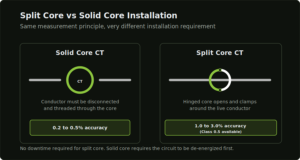
A solid core CT has a single, continuous magnetic core with no opening. To install one, the conductor has to be threaded through the core, which means physically disconnecting the cable first. This is straightforward on new construction, where the wiring is not yet live and not yet connected to anything, but it is a real problem on an existing, operating panel, since installing the CT means de-energizing that circuit first.
In exchange for that installation constraint, solid core CTs generally deliver higher accuracy, commonly in the 0.2 to 0.5 percent error range, which is why they remain the standard choice for revenue-grade metering and new panel builds where accuracy is the priority and a shutdown is not a real obstacle.
3. Split Core CTs: Built to Clamp Around a Live Cable
A split core CT solves the installation problem directly. Its magnetic core is built in two hinged halves that open, get positioned around an existing conductor, and close again, without ever disconnecting the cable or de-energizing the circuit. This single design change is what makes split core CTs the practical option for retrofitting monitoring onto a panel that is already live and already running production.
The tradeoff is a modest one. Because the core has a seam where the two halves meet, split core CTs typically land in a lower accuracy class than solid core designs, commonly 1.0 to 3.0 percent error, though higher-quality industrial split core CTs can reach Class 0.5. For general energy monitoring and sub-metering, this level of accuracy is generally more than sufficient. For legal, revenue-grade billing metering, the tighter accuracy of a solid core CT is usually still the better fit.
4. Why This Distinction Actually Matters for a Factory
The choice between split core and solid core is not really a technology preference, it is a question about what the circuit is doing and whether it can be stopped. A brand new switchgear panel being built from scratch has no such constraint, the conductors are not live yet, so a solid core CT specified at build time costs nothing extra in downtime. An existing, operating panel is the opposite case entirely, stopping it to install a CT means lost production time, and on a critical line, that cost can dwarf the price difference between the two CT types many times over.
The practical rule of thumb: New construction and permanent, high-accuracy revenue metering generally favor solid core. Retrofitting monitoring onto an existing, energized facility, which describes most industrial monitoring projects in Pakistan, generally favors split core.
5. Sizing and Accuracy Class Still Matter
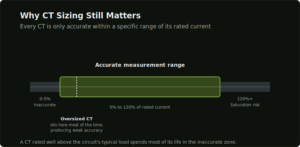
Choosing split core over solid core does not remove the need to size the CT correctly. Every CT is rated for a nominal current, and most only stay accurate within a specific range of that rating, typically from around 5 to 120 percent of nominal current for a standard accuracy class. A CT sized well above the circuit’s actual typical load will sit in the inaccurate low end of its range for most of its operating life, quietly producing numbers that look plausible while under-representing real consumption. Getting the current rating and accuracy class right at the point of selection matters just as much for a split core CT as it does for a solid core one.
6. Where Split Core CTs Fit Into an EMS Deployment
In a typical energy monitoring setup, a split core CT clamps around a conductor, feeds its reduced secondary current into a smart energy meter or analyzer, and that reading is transmitted, often over Modbus, into an energy management platform where it becomes part of the facility’s live dashboard. This is the same chain of components covered in our piece on choosing the right flow meter for different utilities, the underlying principle is consistent across metering technologies: getting accurate, correctly specified data at the measurement point is what everything built on top of it, dashboards, benchmarks, audits, depends on.
7. A Realistic Retrofit Scenario
Consider a facility that wants to start monitoring electricity consumption on ten individual production lines feeding off a shared main panel that has run continuously for years. Using solid core CTs would mean scheduling a shutdown for each of the ten circuits individually, coordinating with production planning, and accepting the associated downtime cost multiplied by ten. Using split core CTs, an electrician can clamp each one around its respective live cable during a normal working shift, with no production interruption at all. The accuracy difference between the two options, in this context, is almost never the deciding factor. The ability to do the work without stopping the line is.
8. When Solid Core Is Still Worth the Downtime
Split core is not universally the better choice. Revenue-grade billing applications, where the metering data has direct financial or legal weight, generally still call for solid core CTs at their tighter accuracy class. New panel construction, where there is no live circuit to interrupt in the first place, also removes the entire rationale for choosing split core, since a solid core CT costs nothing extra in downtime under those conditions and offers better baseline accuracy. The decision genuinely depends on the specific circuit and its constraints, not a blanket preference for one technology over the other.
9. How Daitan Solutions Helps
Daitan Solutions specifies and installs current transformers, split core and solid core alike, matched to the actual constraints of each circuit rather than defaulting to one type across every panel. This includes assessing which circuits can accept a shutdown and which cannot, sizing CTs correctly for the accuracy class the application genuinely requires, and integrating the resulting data into Daitan’s Energy Management System so retrofitted circuits sit on the same dashboard as newly built ones.
Add monitoring without stopping your production line
Daitan Solutions can retrofit accurate energy monitoring onto your existing panels using split core current transformers, with no shutdown required.
10. Frequently Asked Questions
Can a split core CT be installed without shutting down the circuit?
Yes, this is its primary advantage. A split core CT has a hinged, openable core that clamps around an existing, energized conductor without disconnecting it, unlike a solid core CT, which requires the conductor to be threaded through a closed core, meaning the circuit typically needs to be de-energized first.
Are split core CTs less accurate than solid core CTs?
Generally yes, though the gap has narrowed with modern designs. Solid core CTs commonly achieve 0.2 to 0.5 percent accuracy, while split core CTs typically fall in the 1.0 to 3.0 percent range, though higher-quality industrial split core CTs can reach Class 0.5. For general energy monitoring, this difference is usually not significant enough to matter.
Should revenue-grade billing metering use split core or solid core CTs?
Solid core is generally the better fit for revenue-grade or legal billing metering, since its tighter accuracy class matters more when the reading has direct financial or contractual weight, and the installation typically happens once during new construction rather than as a retrofit.
Does CT sizing matter differently for split core versus solid core?
The sizing principle is the same for both. A CT needs to be rated so the circuit’s typical load falls within its accurate measurement range, generally 5 to 120 percent of its nominal current rating. An oversized CT of either type will sit in its inaccurate low range for most of its operating life.
Can split core CTs be used for permanent, long-term monitoring installations?
Yes. Split core CTs are used for both temporary and permanent monitoring installations. Their installation method addresses how they go in, not how long they are meant to stay, and industrial split core CTs are commonly left in place indefinitely as part of a facility’s ongoing monitoring infrastructure.
11. The Bottom Line
The choice between split core and solid core current transformers comes down to one practical question: can this circuit be shut down to install the CT, or not. For new construction, the answer is usually irrelevant, so solid core’s better accuracy wins by default. For the far more common case of adding monitoring to a factory that is already running, split core is what makes the retrofit possible at all, without turning a metering upgrade into a production stoppage.